
Balance board exercises: a progression that works
Almost every balance board guide gives you the same ten moves in the same order. What they rarely give you is the reason the order matters, or any figure you can check. This page does both: the progression below is ordered by how much the surface is allowed to move, and every number on it links to the study it came from.
What balance training actually changes
The 2019 Cochrane review pooled 108 randomised trials covering 23,407 people in 25 countries. It is the largest synthesis of the question that exists, and it did something most summaries skip: it separated exercise types instead of lumping them together.
Rate of falls, balance and functional exercise vs control (rate ratio 0.76, 95% CI 0.70–0.81; 39 studies, 7,920 participants; high-certainty evidence)
— Sherrington et al., Cochrane Database of Systematic Reviews, 2019
Now the part that almost never gets quoted. In the same review, programmes that were primarily resistance training — weights, bands, bodyweight strength without a balance component — came out at a rate ratio of 1.14, with a confidence interval running from 0.67 to 1.97. The interval crosses 1, which means the data cannot even rule out an increase. The reviewers rated it very low certainty and wrote plainly that they were uncertain of the effect.
Rate ratio for resistance training alone (95% CI 0.67–1.97; 5 studies, 327 participants; very low-certainty evidence) — no demonstrated benefit on falls
— Sherrington et al., Cochrane Database of Systematic Reviews, 2019
Getting stronger is worth doing for many reasons. But on this specific outcome, in this specific body of evidence, it is the balance component that carries the effect. A board is one cheap way to train it at home — so is standing on one leg while the kettle boils.
| Exercise type | Effect on rate of falls | Certainty | Evidence base |
|---|---|---|---|
| Balance and functional | −24% (RaR 0.76) | High | 39 studies · 7,920 people |
| Multiple types combined | −34% (RaR 0.66) | Moderate | 11 studies · 1,374 people |
| Tai Chi | −19% (RaR 0.81) | Low | 7 studies · 2,655 people |
| Resistance only | No demonstrated effect (RaR 1.14) | Very low | 5 studies · 327 people |
All four rows: Sherrington et al., Cochrane Database of Systematic Reviews, 2019.
How long should you be able to hold?
A meta-analysis pooled 22 studies and 3,484 people aged 60 to 99, measuring single-limb stance with eyes open. The overall mean was 15.7 seconds, but the age bands are what make it useful, because an average across four decades tells you very little about any one person.
Mean single-limb stance time, eyes open, ages 60–69 (95% CI 20.4–33.7; 11 studies, 851 participants)
— Bohannon, Topics in Geriatric Rehabilitation 22(1):70–77, 2006
| Age | Mean hold, one leg, eyes open | 95% confidence interval | Basis |
|---|---|---|---|
| 60–69 | 27.0 s | 20.4 – 33.7 s | 11 studies · 851 people |
| 70–79 | 17.2 s | 11.6 – 22.8 s | 12 studies · 870 people |
| 80–99 | 8.5 s | 1.0 – 16.1 s | 6 studies · 146 people |
Bohannon, Topics in Geriatric Rehabilitation, 2006. Floor, not board — a board will be considerably harder.
Look at the confidence intervals before you compare yourself to the mean. At 80–99 the interval runs from 1 second to 16 — the spread within an age band is wider than the gap between bands. Your own number last month is a better benchmark than anyone else's.
The progression, in order
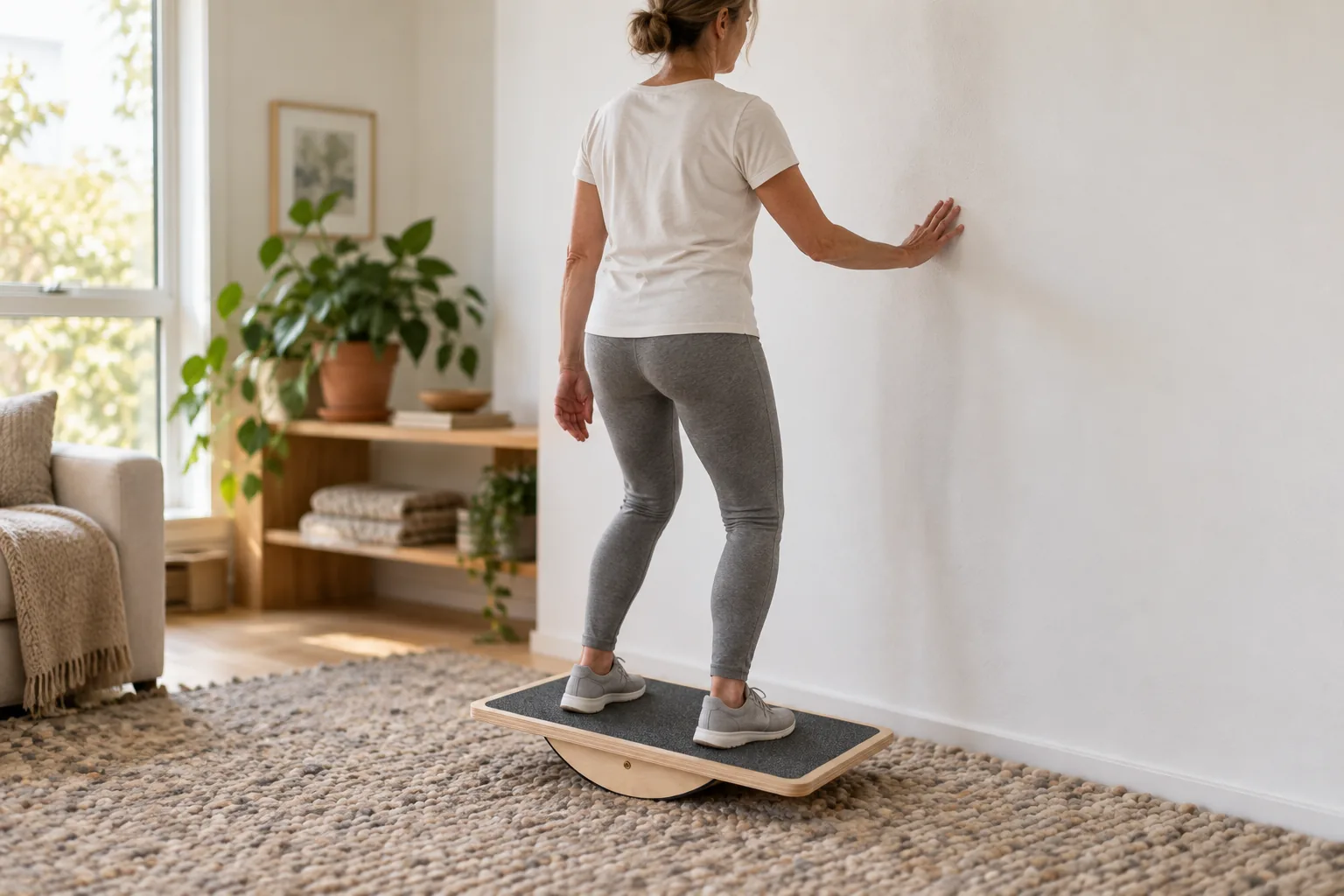
- Two-foot static hold, hand on a wall. Feet shoulder-width, weight through the middle of the foot. Thirty seconds. This is the step most people rush.
- Two-foot static hold, fingertips only. Same thing, but you are allowed one finger on the wall. You will notice how much you were leaning.
- Two-foot static hold, no hands. Arms loose at your sides, not out like a tightrope walker — the arms are a crutch too.
- Front-to-back rocking. Let one edge touch down, then the other, slowly. Rhythm matters more than range.
- Side-to-side rocking. Harder than it looks on a rocker board, easy on a wobble board — which is one practical difference between the two shapes.
- Hold with head turns. Turning your head disturbs the vestibular input. This is where balance training stops being leg work.
- Hold with eyes closed. Removing vision is the single biggest step up on this list. Wall within reach, always.
- Quarter squats. Small range, slow, controlled. Stop the moment the board starts slapping down.
- Single-leg stand, hand on wall. Only once the two-foot eyes-closed hold is comfortable.
- Single-leg stand, no hands. The end of the progression for most people, and plenty.
If your interest is ankle rehabilitation rather than general balance, the ordering changes and the board type changes with it — a single-foot ankle board isolates the joint in a way a full-size board does not. If you want to train while you work rather than in sessions, a standing desk board is a different object with a different movement range, and we wrote separately about how long to actually stand.
If you are training for a recovered ankle
A 2024 systematic review pooled nine randomised trials covering 341 patients with chronic ankle instability. Against no treatment, balance training improved the CAIT score by 3.95 points and the FAAM Sports score by 17.74 points. Against strength training, the two were equivalent on dynamic stability, with balance training ahead on the functional scales.
341 patients with chronic ankle instability; balance training improved FAAM Sports by 17.74 points vs control (95% CI 14.36–21.11, P < 0.00001)
— Guo et al., Systematic Reviews, 2024
One thing that review cannot tell you: whether your ankle is ready. If you are inside the window after an injury, or the joint still gives way, that is a question for the person treating you, not for a web page.
Four mistakes worth avoiding
- Training tired. Control disappears before strength does. The last two minutes of a long session are where people fall.
- Bare feet on a slick board. Grip matters more than feel at the start.
- Arms out wide. It makes the hold easier, which means you are training an easier task than the one you wanted.
- Chasing the next step. The progression works because each stage is dull before you leave it.
Two related reads, if you want the evidence rather than the routine: whether balance boards actually work goes deeper into the trials, and the downsides of using a balance board covers what the research says about risk. If you are choosing between shapes, balance board or wobble board sets out the difference, and our wobble board page covers that shape on its own. For older beginners, balance exercises for seniors starts further back than this page does. There is also a separate guide for children, who need a different board entirely.
Choosing a board for this progression
Steps 1 to 8 work on almost anything with a curved underside. Steps 9 and 10 need a board wide enough that a single foot sits fully on it. If you have not bought one yet, our comparison sets out the criteria before it sets out products, and how we test explains what we actually check. You can also see the Stavik range — two boards, and we say plainly which one each progression step suits.
Questions people ask
Is using a balance board good exercise?
For balance specifically, yes — and the evidence is unusually clear. The 2019 Cochrane review of 108 trials found that balance and functional exercise reduces the rate of falls by 24%, rated high-certainty evidence. It is not cardiovascular exercise and it will not build much muscle; it trains the reflex that catches you.
How long should you be able to stand on a balance board?
There is no published norm for a board, but there is one for standing on one leg on the floor: a meta-analysis of 22 studies found mean times of 27.0 seconds at 60-69, 17.2 seconds at 70-79 and 8.5 seconds at 80-99. On a board, expect far less at first. Thirty seconds of controlled two-foot balance is a reasonable first target.
How often should I train on a balance board?
Short and frequent beats long and rare. Most trials in the Cochrane review ran programmes of 12 weeks or more, and nearly a third lasted a year or more — the benefit comes from continuing, not from intensity. Five to ten minutes on most days is enough to progress.
What are the downsides of using a balance board?
The obvious one is falling off. Train beside a wall or a worktop until the first stand is boring, keep the floor clear for at least a metre around you, and stop the session when you get tired — fatigue is when control goes. We cover the rest in our piece on balance board downsides.
Sources on this page: Sherrington C, Fairhall NJ, Wallbank GK, Tiedemann A, Michaleff ZA, Howard K, Clemson L, Hopewell S, Lamb SE. Exercise for preventing falls in older people living in the community. Cochrane Database of Systematic Reviews, 31 January 2019 · Bohannon RW. Single Limb Stance Times: A Descriptive Meta-Analysis of Data From Individuals at Least 60 Years of Age. Topics in Geriatric Rehabilitation 22(1):70–77, 2006 · Guo Y, Cheng T, Yang Z, Huang Y, Li M, Wang T. A systematic review and meta-analysis of balance training in patients with chronic ankle instability. Systematic Reviews, 2024. Last reviewed 15 September 2026.